 Size Run
Free size curve template for apparel buyers
Turn last season's units by size into a buy plan. Free.
Fashion template bundle for small labels: line sheet, tech pack and production tracker, what each one covers, plus a worked margin example.
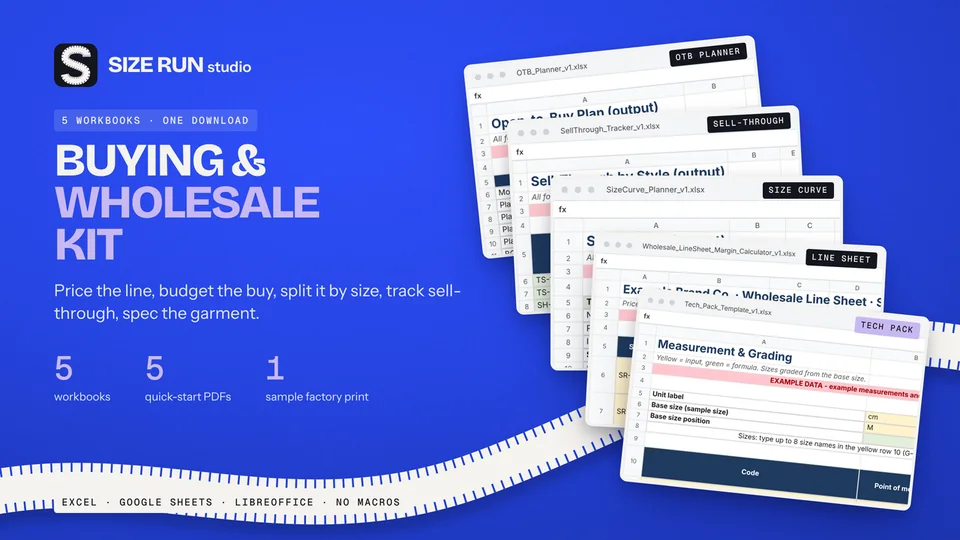
Before the first order goes out, a small label usually needs three documents: a line sheet for buyers, a tech pack for the factory and a tracker for samples and orders. This page explains what each one does, how they fit together, and walks through one margin example with invented numbers.
Each document answers a different person. The buyer asks what a style costs and what can be ordered. The factory asks how exactly it is made. You ask what is late. Putting all three questions into one long sheet works for a handful of styles and gets hard to read at the first revision, so it helps to keep them apart and use the same style code in every file.
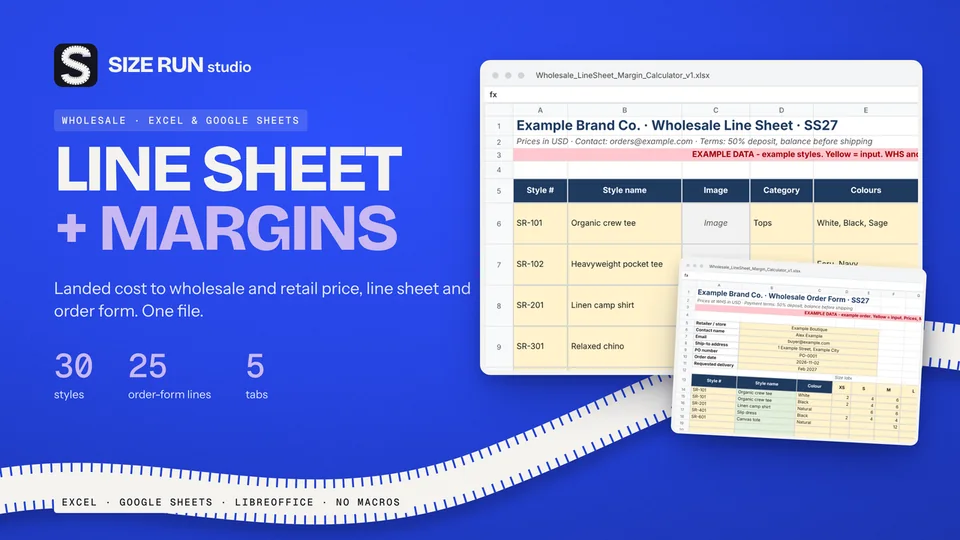
1. Line sheet and margin calculator. One row per style. It works out landed cost from unit cost, freight, duty percentage and other per-unit costs, then suggests a wholesale price and a retail price from two multipliers you can edit. It shows brand margin, retailer margin and a keystone check, and it holds a line sheet you can export as a PDF for buyers plus an order form. There is room for 30 styles and 25 order lines.
2. Tech pack. One style per file. It holds a spec sheet, a bill of materials with 25 lines, graded measurements for 25 points across 8 sizes with a tolerance check, and costing that ends in landed cost. A factory print tab leaves out all prices, so you can send it as it is.
3. Production tracker. Up to 100 sample rounds and 60 purchase orders with risk flags. A time and action calendar counts back from your in-store date, a vendor scorecard keeps your own notes, and a dashboard shows what is late.
These figures are made up to show the arithmetic. Duty rates and multipliers differ by product and country, so use your own.
A tee has a unit cost of 9.50, freight of 0.80 per unit, duty of 10 percent and 0.50 of other costs per unit.
If the margin falls below your own target, change the multiplier or the cost and keep the target fixed.
Everything above works in a plain spreadsheet, and building your own is a good way to learn the logic. A ready set saves the setup time and gives you the layout of a buyer line sheet, a factory print and a sample log from the start.
The bundle does not include size-run buying or open-to-buy planning. It is a planning aid, not financial, tax, legal or production-quality advice. Microsoft Excel is a trademark of its owner, and Size Run Studio is not affiliated with it.
The Fashion Brand Bundle is a paid digital download on Etsy: three Excel workbooks, a one-page Quick Start PDF for each, and a filled sample factory print as PDF. Nothing is shipped, and you start with clearly marked example data that you replace with your own.
See the Fashion Brand Bundle on Etsy
Three working documents: a line sheet with a margin calculator for buyers, a tech pack for the factory, and a production tracker for samples, orders and dates. Each one answers a different question, so each is its own workbook.
No, they are separate files. Use one style code per style in all three so you can find the same style quickly in each.
The workbooks are made for Excel. The production tracker also works in LibreOffice. Other spreadsheet programs have not been tested.
No. All example data, duty rates, lead times and prices are invented placeholders. Replace them with figures from your own factory and advisers.
Turn last season's units by size into a buy plan. Free.
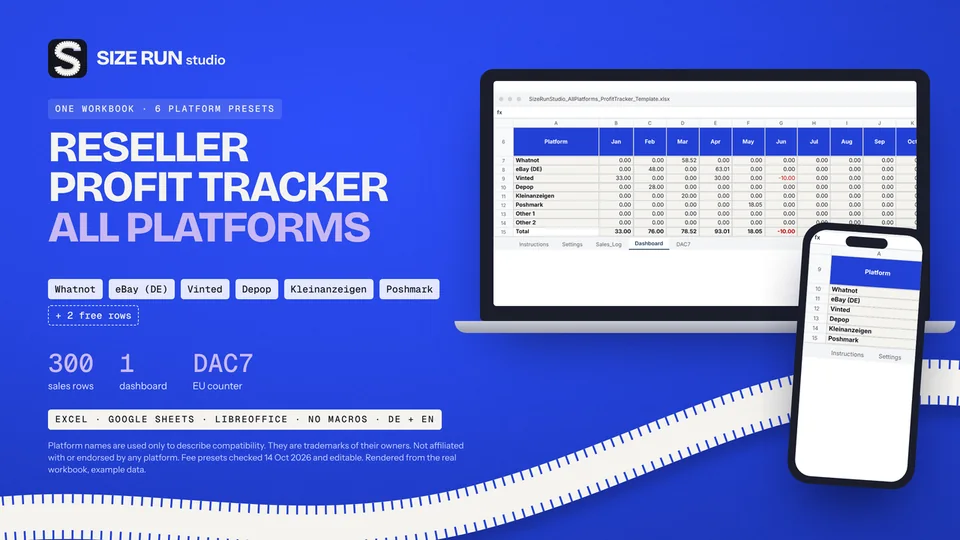
Fees, net profit, margin and ROI per platform and month.
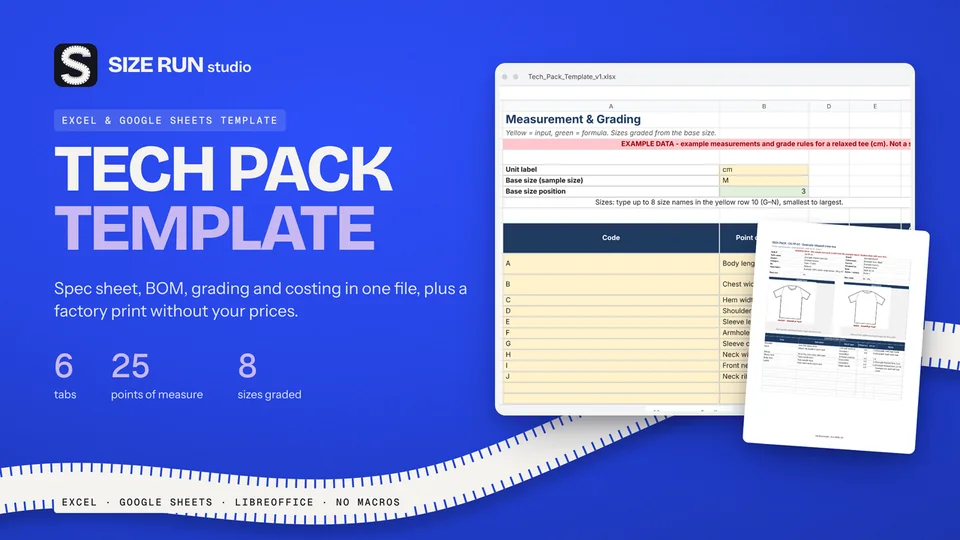
Spec sheet, BOM, grading and costing in one file.
A worked example, step by step, from net units to units per size.
What you keep per resale after fees and shipping.
The open-to-buy formula with a worked example, at retail and at cost.
Sell-through rate and weeks of cover, with a worked example.
Why a 50% markup is not a 50% margin, with a worked example.
What a production tracker needs, how to flag late samples and orders, with a worked example.
Which columns a wholesale price list needs and how to price from landed cost, with a worked example.
Fee, net profit, margin and ROI per sale, with a worked example and editable fee rates.
How to track bookings, host fee, payout, occupancy and profit per property, with a worked example.
Track Etsy fees, net profit and margin per sale, with a worked example and editable fee rates.
How to track invoices, overdue payments, income and profit per hour, with a worked example.
How to budget when every month pays differently: baseline, buffer and set-aside, with a worked example.
How to track wedding vendor deposits, balances and due dates in one spreadsheet, with a worked example.
Invoice tracker and irregular-income budget planner in one bundle, with worked examples.