 Size Run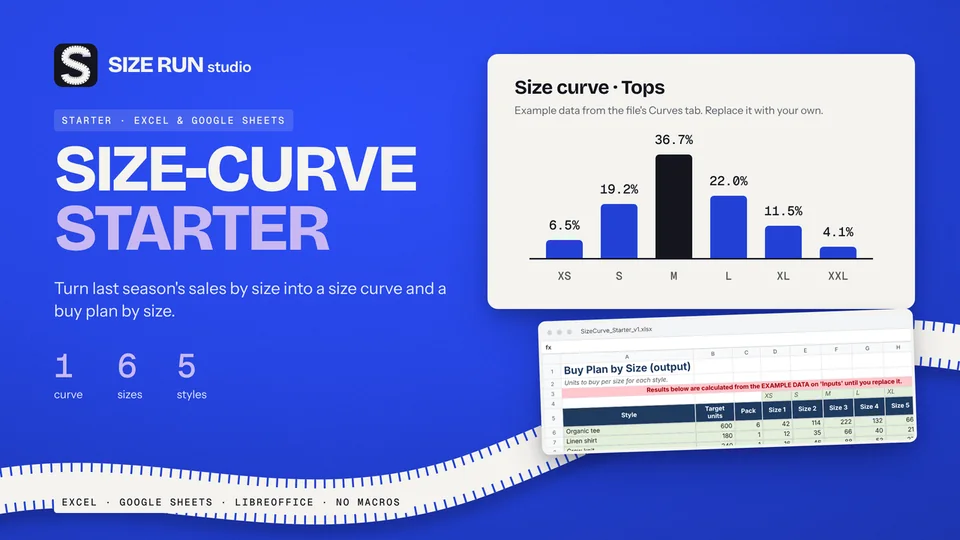
Free size curve template for apparel buyers
Turn last season's units by size into a buy plan. Free.
Markup vs margin explained for fashion wholesale: two formulas, one worked example from cost to wholesale to retail, and how to convert between them.
Markup and margin describe the same profit in two different ways, and mixing them up is one of the most common pricing errors in wholesale. This page gives both formulas, one worked example from landed cost to wholesale price to retail price, and a simple conversion.
Markup measures profit against cost. Margin measures profit against selling price. Because price is larger than cost, the margin percentage is always smaller than the markup percentage for the same sale.
Price is whatever the seller charges. In wholesale, the brand sells at the wholesale price (WHS) and the retailer sells at the recommended retail price (RRP). Each side has its own cost and its own price, so each side has its own markup and margin.
These figures are made up to show the arithmetic. They are not market data. One style, in EUR.
Brand side: landed cost 40, wholesale price 80.
Retailer side: buys at 80, sells at an RRP of 160 (ignoring VAT to keep the arithmetic simple).
Doubling the price from wholesale to retail is called keystone pricing. It always gives a 100% markup and a 50% margin, which is why "keystone" is a common starting point in fashion retail.
Take the same landed cost of 40 and apply a 50% markup: 40 x 1.5 = 60. Profit is 20. Margin = 20 / 60 = 33.3%.
If a brand wants a 50% margin and mistakenly applies a 50% markup, it prices at 60 instead of 80 and earns 20 per unit instead of 40. Across a full order, that difference is large.
A quick check: the markup percentage is always bigger than the margin percentage, unless both are zero. If your margin comes out larger than your markup, one of the two has been calculated on the wrong base.
Fashion brands usually move through several price points. Landed cost (unit cost plus freight, duty and other per-unit costs) is the base. A multiplier gives the wholesale price, and a second multiplier gives the retail price. Both sides of that chain deserve their own check:
A line sheet that shows WHS and RRP next to each other makes this conversation with a buyer much easier.
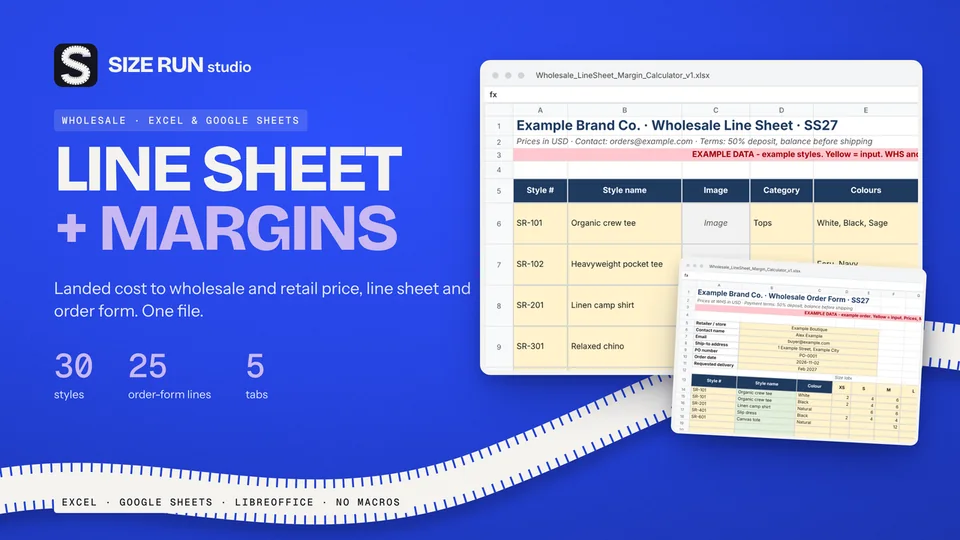
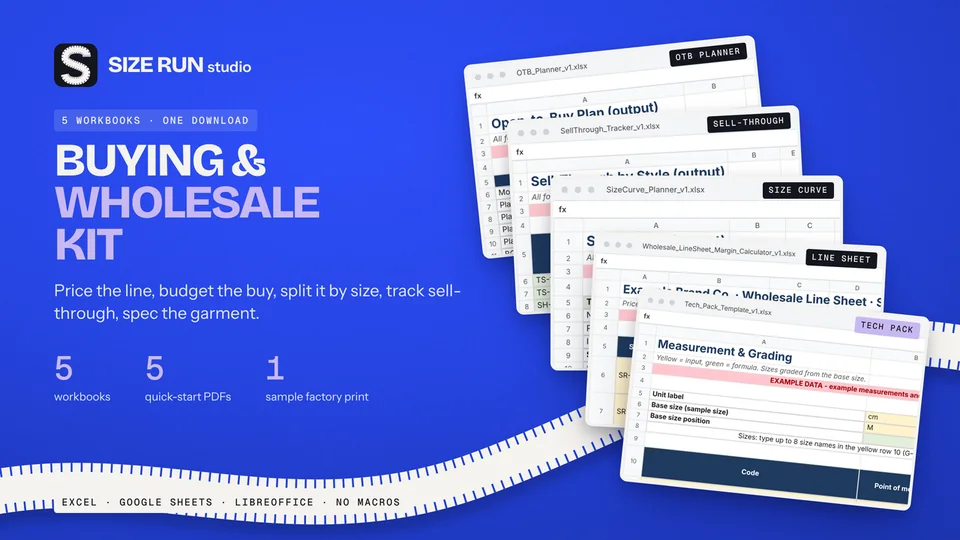
The Wholesale Line Sheet + Margin Calculator calculates landed cost, suggested wholesale and retail prices, brand margin on wholesale, brand markup on cost, retailer margin on retail and a keystone check for up to 30 styles. It includes an order form with minimum order checks and ships with labelled example data that you replace with your own figures. It is a planning aid and does not set prices for you.
It is a paid product and is also part of the Buying & Wholesale Kit. The formulas above work in any spreadsheet for free.
See the Wholesale Line Sheet + Margin Calculator Line Sheet template on Etsy
Markup is profit as a percentage of cost. Margin is profit as a percentage of selling price. The same sale gives two different percentages.
Margin = markup / (1 + markup). For example, a 50% markup (0.5) gives 0.5 / 1.5 = 33.3% margin.
Keystone means a retail price of twice the wholesale price. That is a 100% markup on the wholesale price and a 50% margin on the retail price.
No. They are invented to show the arithmetic and are not market data.
Turn last season's units by size into a buy plan. Free.
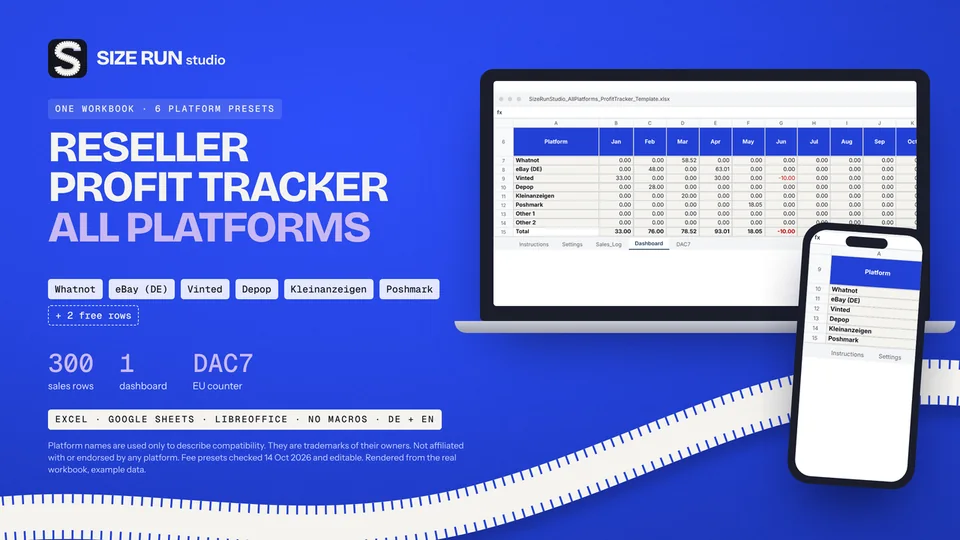
Fees, net profit, margin and ROI per platform and month.
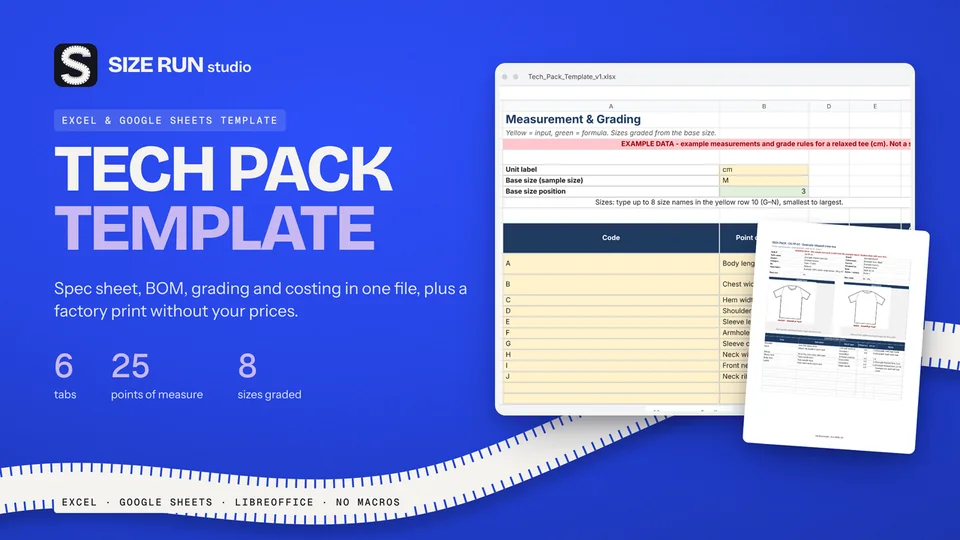
Spec sheet, BOM, grading and costing in one file.
A worked example, step by step, from net units to units per size.
What you keep per resale after fees and shipping.
The open-to-buy formula with a worked example, at retail and at cost.
Sell-through rate and weeks of cover, with a worked example.
What a production tracker needs, how to flag late samples and orders, with a worked example.
Which columns a wholesale price list needs and how to price from landed cost, with a worked example.
Fee, net profit, margin and ROI per sale, with a worked example and editable fee rates.
Line sheet, tech pack and production tracker: what each covers, plus a worked margin example.
How to track bookings, host fee, payout, occupancy and profit per property, with a worked example.
Track Etsy fees, net profit and margin per sale, with a worked example and editable fee rates.
How to track invoices, overdue payments, income and profit per hour, with a worked example.
How to budget when every month pays differently: baseline, buffer and set-aside, with a worked example.
How to track wedding vendor deposits, balances and due dates in one spreadsheet, with a worked example.
Invoice tracker and irregular-income budget planner in one bundle, with worked examples.